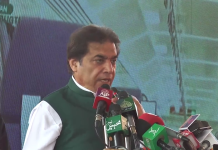
ISLAMABAD, Sep 03 (APP): Chief Justice of Pakistan (CJP), Justice Gulzar Ahmed on Thursday said that the judicial system of Pakistan was fully codified by laws, and its practices were also governed by laws and rules, which were also duly codified.
He said this while addressing the course participants of national security and war course-2021 during their visit to Supreme Court.
Welcoming the participants, the Chief Justice said that the main purpose of war course participants visit to the Supreme Court of Pakistan was to get an orientation on the judicial system of Pakistan.
He said like other countries of the world, Pakistan also had its own judicial system. The judicial system in Pakistan, as it is now, had its own history of evolution and was rooted in the times of Hindu rule of India, Muslim rule of India and the British Colonial period, he said.
CJP said that after the end of British rule in the year 1947 and the creation of the independent state of Pakistan, the judicial system had further evolved through indigenous experiences and learning. Indeed, this process of refinement was ongoing and shall keep continuing, he added.
He said as an introduction, it was essential to mention some basic features having relevance to the judiciary in Pakistan. Pakistan was a Federal Republic known as the Islamic Republic of Pakistan and Article 1 of the Constitution provides for the same, he added.
He said “It has four federating territories that are the Provinces of Baluchistan, the Khyber Pakhtunkhwa, the Punjab and Sindh alongside the Islamabad Capital Territory. Article 175 of the Constitution deals with the judicature and provides that there shall be a Supreme Court of Pakistan and a High Court for each province and the Islamabad Capital Territory, and such other Courts that may be established by law.”
Furthermore, by a Presidential Order No.1 of 1980, Chapter 3A was added to the Constitution by which the Federal Shariat Court was constituted. The matter regarding the Federal Shariat Court will be dealt with by him separately, he added.
He said “As of now, I will deal with the subject of the Supreme Court, the High Courts of the Provinces and the ICT, and other Courts created by law. The most likely way of explaining the judicial system of Pakistan, as regards ordinary cases, and I say ordinary cases for the reason that there are also Special Courts and Tribunals created by law to deal with special cases and their hierarchy is also provided by such laws. There is a four-tier judicial system operating in Pakistan, both for ordinary civil and ordinary criminal cases.”
He said that the lowest rank of civil courts was called the Court of a Civil Judge. In this Court, all civil suits originate except in the territory of Karachi, where the High Court has also been given original civil jurisdiction to try suits having pecuniary value of rupees 15 million and above for the territory of Karachi, he added.
He said that the suits valued at less than these pecuniary values in the territory of Karachi originate in the Court of a Civil Judge.
He said that the second tier was the Court of District Judge, which exercises revisional and appellate jurisdiction against the judgments, orders and decrees passed by the Courts of Civil Judge.
He said that the third tier was the High Court, which exercises revisional and appellate jurisdiction over the judgments, orders and decrees passed by the District Judges. The fourth tier was the Supreme Court, which was the final Court of appeal against the judgments, orders and decrees passed by the High Courts.
In the civil suits which originate in the High Courts in the territory of Karachi and ICT, appeals against the judgments, orders and decrees were filed in the same High Court, these were heard normally by a Division Bench of the same High Court, he said and added that against the judgments, orders and decrees passed by the Division Bench of these High Courts, petitions/appeals lie to the Supreme Court, which was the final court.
He said that the high courts in Pakistan were also conferred the special jurisdiction of judicial review by way of Article 199 of the Constitution, under which it issues writs; popularly known as the writ of mandamus (a command to a lower Court or person ordering them to perform their duty), certiorari (through which a High Court reviews a case tried by a lower Court), prohibition (through which a Court prohibits the doing of something against the law), habeas corpus (through which a Court can inquire into the legality of a person’s detention), and quo warranto (through which the Court may direct someone to show under what authority he has exercised a right or power).
He said that the Supreme Court was also conferred by the Constitution, the original jurisdiction to adjudicate and determine disputes between two governments, that was between the Federal and a Provincial Government or between two Provincial Governments. He said that the Supreme Court had also been conferred original jurisdiction of hearing and deciding Constitution Petitions involving question of public importance with reference to enforcement of any of the Fundamental Rights.
The Supreme Court also has advisory jurisdiction to give opinions on questions of law of public importance referred to it by the President.
The judgments, orders and decrees passed by the Court of Civil Judge are executed in the same Court, while judgments, orders and decrees passed by the High Courts’ exercising their original jurisdiction are executed by the concerned High Court itself. The judgments, orders and decrees passed by the Supreme Court are enforceable throughout Pakistan and where it is to be executed in a Province, it is executed by the High Court of the said Province.
The Court of Civil Judge, District Judge, and the High Court have been conferred jurisdiction of reviewing their own judgments, orders and decrees. The Supreme Court has also been conferred jurisdiction of reviewing its own judgments, orders and decrees.
He stated that the lowest tier of criminal Courts was the Court of a Judicial Magistrate, which was competent to try offences in which the maximum punishment that could be awarded to an accused was up to three years.
He said that the second tier was the Court of Sessions Judge, where not only revisions and appeals were filed against the orders passed by the Judicial Magistrates but the Sessions Judge also had the jurisdiction to try criminal cases having sentences of more than three years and that may also carry the death penalty. The third tier was the High Court where revisions and appeals lie against the orders passed by the Session Judges, he added.
He said that the fourth tier was the Supreme Court of Pakistan, which was the final Court in deciding criminal cases arising out of the orders passed by the High Courts.
In terms of Chapter 3A of the Constitution, the Federal Shariat Court had been constituted and conferred exclusive jurisdiction to examine and decide questions of whether any law or provision of law, was repugnant to the injunctions of Islam, as laid down in the Holy Quran and Sunnah of the Holy Prophet (PBUH) and had also been conferred appellate and revisional jurisdictions in cases arising out of hudood laws, he added.
From the final decision of the Federal Shariat Court, an appeal lies to the Supreme Court of Pakistan and the bench hearing such appeal is called the Shariat Appellate Bench.
The Chief Justice said that a large number of special Courts and Tribunals had been constituted under special laws having special jurisdiction to deal with cases involving the subject provided in the special law. Among the Special Courts and Tribunals, that had been created by special laws, were the special Courts of Banking, Labour, Customs, Taxation and Anti-Corruption, and the Tribunals for Income Tax, Insurance, Service, and Elections etc. Invariably, appeals from these Special Courts and Tribunals lie directly to the High Courts, except in the cases of Service Tribunals and Election Tribunals where the appeals directly lie to the Supreme Court.
“To my estimation, this is the brief outline of the Judicial System of Pakistan and the relevant provisions of the Constitution of the Islamic Republic of Pakistan. I believe that some manner of understanding regarding the Judicial System of Pakistan and Constitutional provisions may have been developed by these outlines,” he concluded.